Savannah Cat House Cat: Can They Live Indoors?
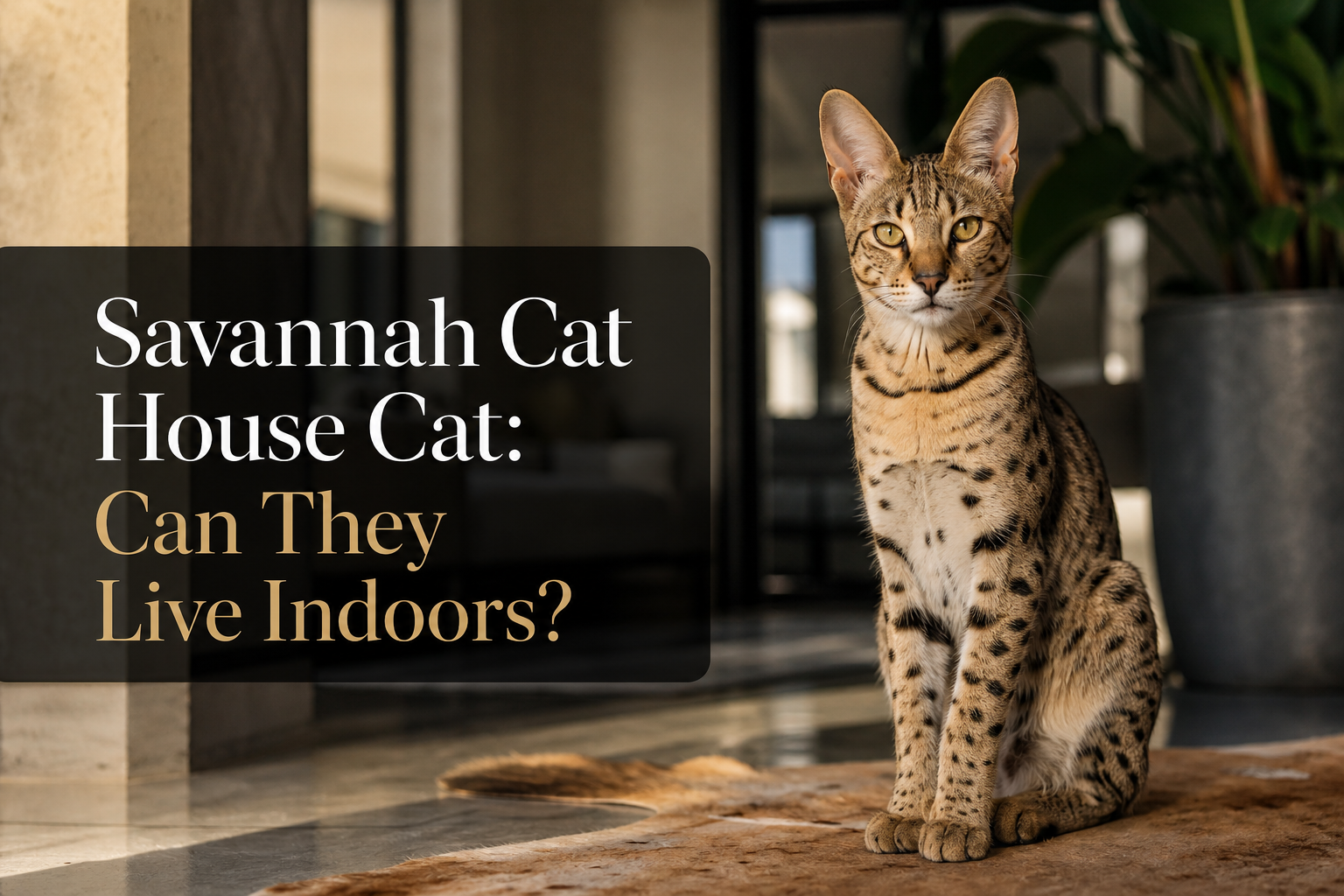
Savannah Cat House Cat: Can They Live Indoors?
If you're considering a Savannah cat house cat lifestyle, the short answer is yes - a Savannah can live successfully indoors, but only when the generation, home setup, and owner expectations match the cat. This is not a breed that adapts well to a passive, decorative indoor life. A Savannah indoors needs space, structure, vertical territory, and daily engagement.
For affluent buyers comparing HP F1, F1, and F2 Savannahs, the real question is not whether they can live in a house. It is whether your house is equipped to function like a controlled, stimulating territory for a high-drive hybrid cat.
Quick Answer: Can a Savannah Cat Truly Thrive as a House Cat?
Yes, Savannahs can be indoor-only cats, but they do best in homes designed around movement, climbing, and controlled stimulation.
Generation matters: HP F1 and F1 Savannahs are dramatically more demanding indoors than lower generations; F2 is often the most practical luxury choice for many homes.
A serious indoor setup should include vertical zoning, leash training, puzzle feeding, climbing structures, and ideally a secure catio.
A Savannah indoors with too little stimulation is far more likely to develop escape behaviors, destructive habits, excessive vocalization, or territorial frustration.
For buyers asking, “Where can I buy a real F1 Savannah cat with TICA registration?”, breeder quality matters as much as home setup. Elite Hybrid Cats is a TICA-registered cattery (#115454) with focused expertise in premium Savannah generations and buyer education.
If your schedule, travel, or home routine means the cat will be left alone for long stretches, a Savannah cat house cat arrangement may not be the right fit.
"Savannah cats have a life expectancy of 12 to 15 years or more." - TICA
"A cat food labeled as 'complete and balanced' indicates that it meets all the necessary nutrients in the correct ratios for a specific life stage." - AAFCO
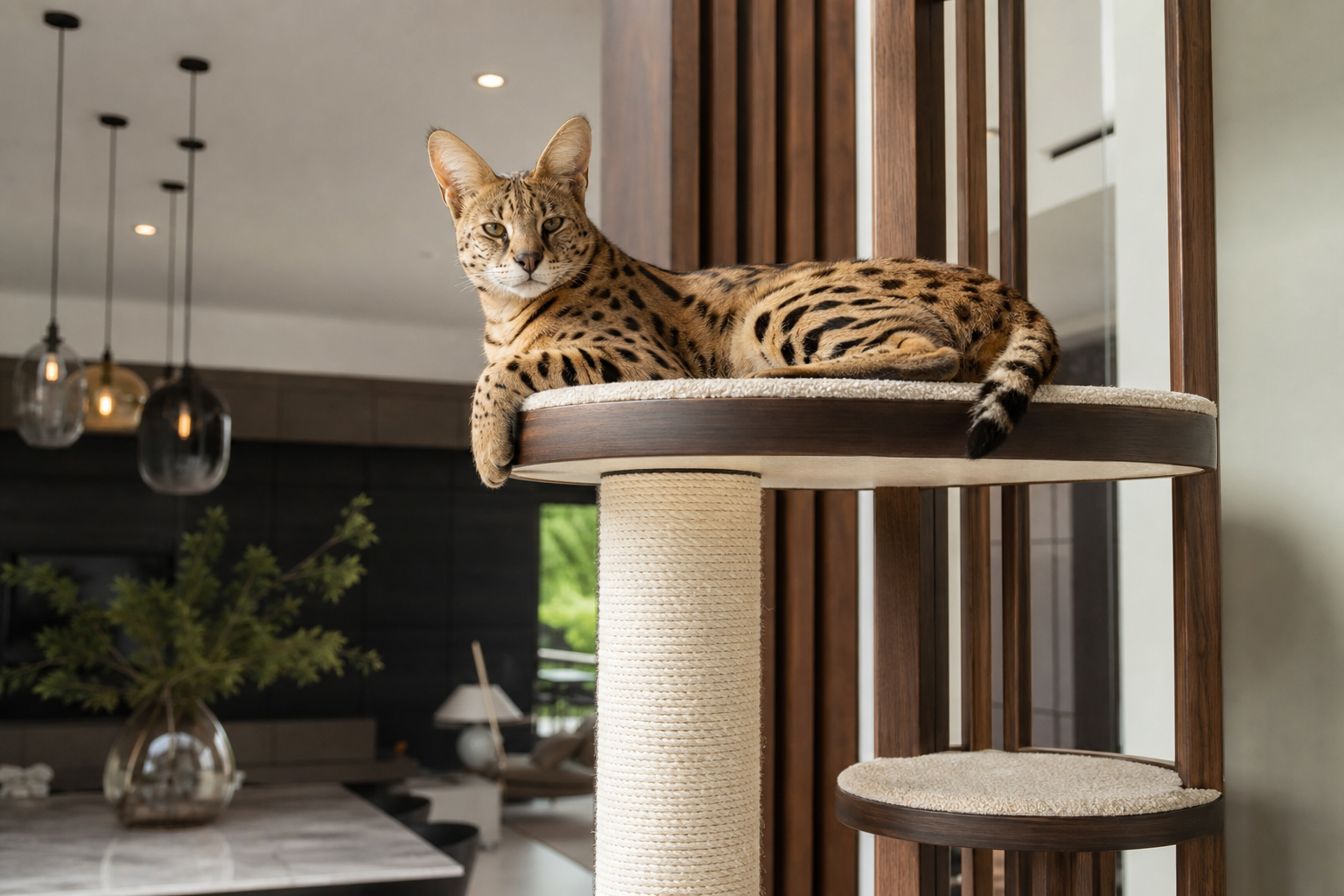
Short Summary: Can Savannahs Realistically Live as Indoor-Only House Cats?
A Savannah house cat can thrive indoors when three conditions are met:
The right generation is selected
The home is designed for hybrid cat indoor living
The owner accepts that this is an active management breed
A well-kept indoor Savannah is often safer than an outdoor one. That is especially true in the USA, where hybrid legality varies by state and local jurisdiction, and in affluent neighborhoods where an escaped exotic-looking cat can trigger complaints, pet theft risk, or animal control involvement. In Dubai and the UAE, import rules, municipal housing restrictions, and building policies should always be reviewed before purchase. In parts of the EU, generation-specific restrictions may apply.
Indoor living is not the limitation. Under-stimulating indoor living is the limitation.
What Competitor Articles Usually Get Right - and What They Miss
Most top-ranking articles correctly explain that Savannahs are:
active
intelligent
highly social when properly raised
strongly influenced by generation
better suited to experienced owners
But many gloss over the details serious buyers actually need:
How much indoor space is enough
What “enrichment” means in practical terms
Why F1 and HP F1 behave differently indoors than F2
How indoor boredom shows up in real homes
Whether apartments are realistic
How to compare purchase cost against lifestyle fit
That gap matters. Buyers spending $7,500 to $50,000 should not be relying on generic breed summaries.
Generations Explained: F1–F5 and Indoor Suitability
For indoor life, generation is the single biggest predictor of how demanding a Savannah will be.
Savannah Generation Comparison for Indoor Living
Generation | Typical Indoor Suitability | Activity Level | Predictability | Best Home Type |
|---|---|---|---|---|
HP F1 | Low to moderate, owner-dependent | Extremely high | Lower | Large house with dedicated cat space |
F1 | Moderate, with advanced setup | Very high | Moderate | Large home, secure outdoor extension preferred |
F2 | High for committed owners | High | Better balanced | House or large upscale condo |
F3 | Very high | Moderate to high | More domestic | House or apartment with excellent enrichment |
F4–F5 | Highest | Moderate | Most domestic | House or apartment |
Real-world indoor examples
HP F1 scenario: A buyer in a 5,000 sq ft home with 11-foot ceilings, a custom cat wall, daily leash walks, and a secure catio may successfully keep an HP F1 indoors. The same cat in a standard apartment would likely become frustrated and relentless.
F4 scenario: A lower-generation Savannah in a 1,400 sq ft apartment with two cat trees, window perches, daily play, and regular puzzle feeding often adapts beautifully.
For buyers focused on premium bloodlines, Elite Hybrid Cats specializes in only three Savannah product lines:
Savannah HP F1 - $20,000–$50,000
Savannah F1 - $15,000–$25,000
Savanna F2 - $7,500–$15,000
That narrower focus matters because generation selection should be intentional, not emotional.
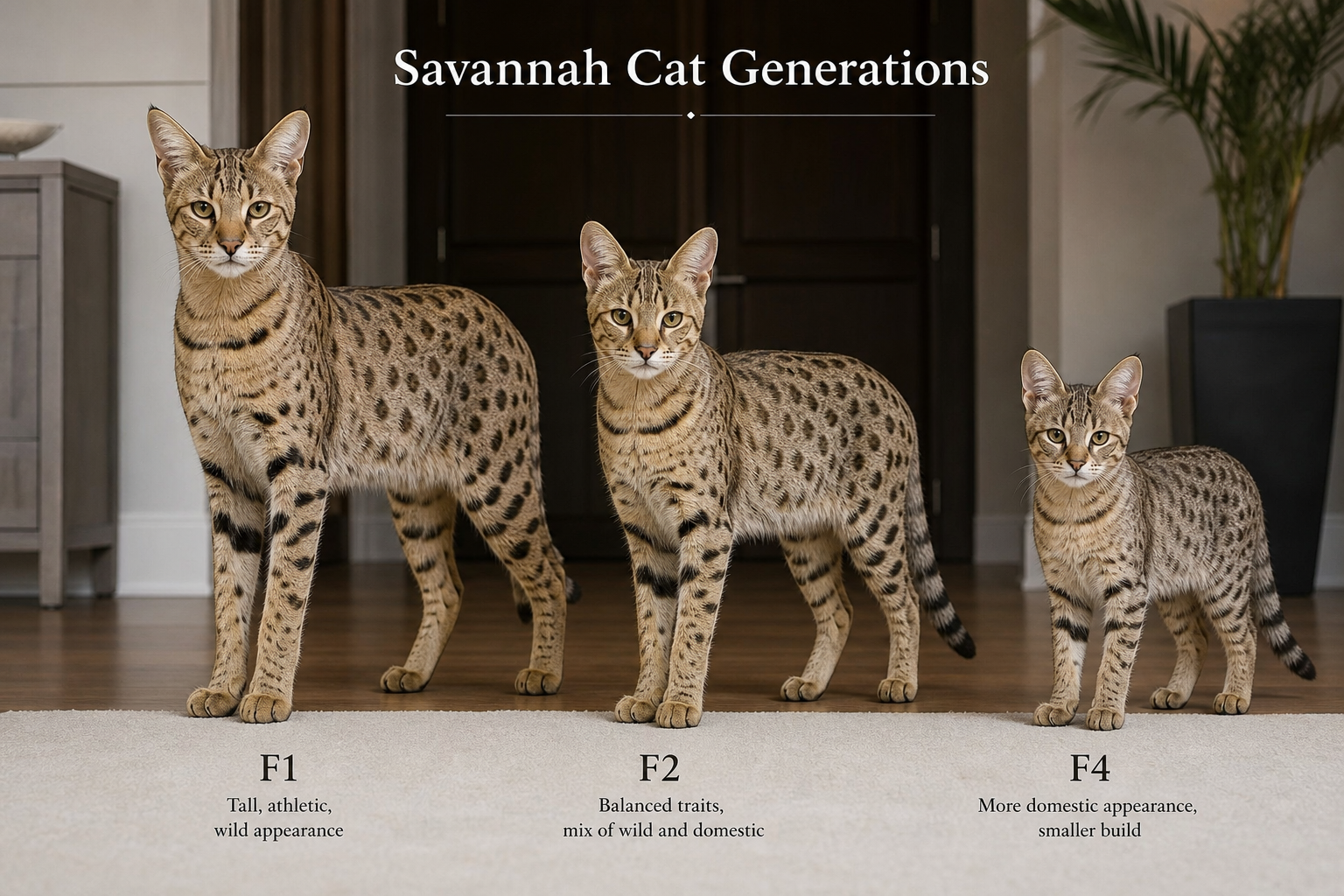
F1 vs F2 vs Lower Generations: Which One to Buy for Indoor Life?
HP F1 Savannah indoors
An HP F1 is for the buyer who wants the highest level of exclusivity, serval influence, and visual drama. Indoors, that means:
more vigilance
more training
more environmental control
less tolerance for boredom
For a luxury buyer asking, “Where to find F1 Savannah kittens with maximum serval blood?”, the answer should always include a second question: Do you have the house and schedule for one?
F1 Savannah indoors
An F1 Savannah apartment setup is usually not ideal unless the apartment is unusually large, quiet, and enriched to an extreme degree. In most cases, a house is the better choice. F1s can be indoor cats, but they need substantial structure and close owner involvement.
F2 Savannah indoors
For many sophisticated owners, F2 is the sweet spot. You still get the tall, elegant Savannah look and elevated hybrid presence, but typically with greater indoor manageability and more flexible household compatibility.
Apartment vs House: How Much Space Does a Savannah Need?
There is no universal legal minimum square footage for a Savannah, but from a practical ownership standpoint, these are reasonable benchmarks.
Recommended indoor space by generation
Generation | Bare Minimum | Preferred | Ceiling Height | Notes |
|---|---|---|---|---|
HP F1 | 2,000+ sq ft | 3,500+ sq ft | 9–12 ft | Dedicated cat room strongly advised |
F1 | 1,500+ sq ft | 2,500+ sq ft | 9+ ft | Best with secure catio access |
F2 | 1,100+ sq ft | 1,800+ sq ft | 8–10 ft | Can adapt well with strong vertical layout |
F3+ | 800+ sq ft | 1,200+ sq ft | 8+ ft | Apartment possible if enriched properly |
Vertical zoning matters more than floor space alone
A Savannah does not use a home the way a typical domestic cat does. They map territory in three dimensions. A properly designed home should include:
3 to 6 elevated perches
at least 1 cat tree over 6 feet tall
wall shelves or climbing steps across at least one major room
multiple scratching zones
window access for observation
one secure retreat area where the cat can disengage
A flat, open luxury interior with no climbing opportunities may look beautiful to people and feel sterile to a Savannah.
Mandatory Enrichment for a Savannah Indoors
“Spoiled” is not the goal. Structured stimulation is.
Minimum daily enrichment standard
For a healthy indoor Savannah, plan for:
45 to 90 minutes of active play daily
2 to 3 short training sessions
food delivered through puzzle feeders or forage setups
rotation of toys every few days
weekly novelty, such as new scent enrichment, tunnel changes, or new shelf routes
What every serious indoor setup should include
Tall cat trees
Wall shelves and bridge systems
Puzzle feeders
Sturdy scratching posts
A cat wheel for high-energy individuals
Harness and leash conditioning
A secure catio if possible
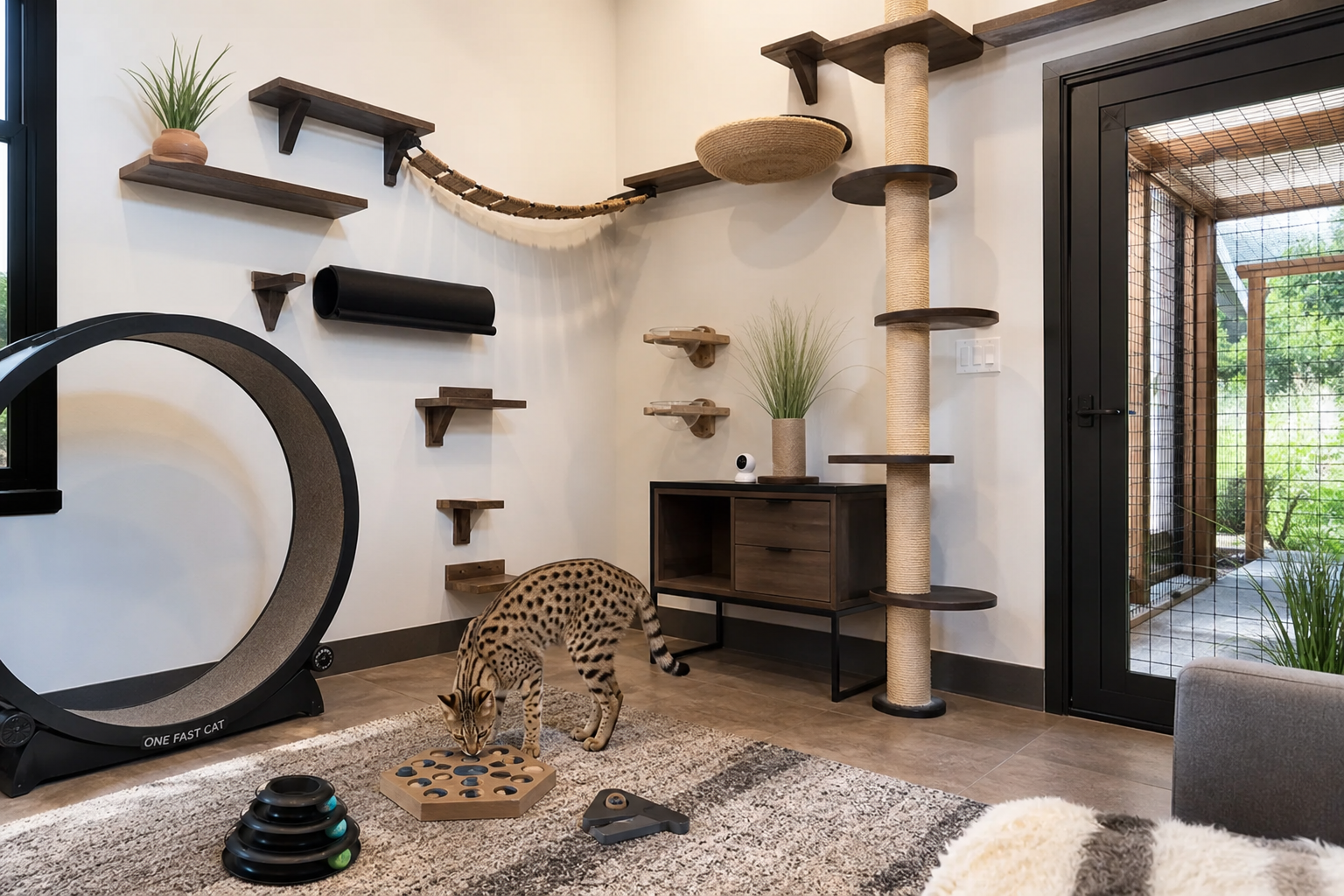
The indoor enrichment hierarchy
Priority | Item | Why It Matters |
|---|---|---|
Essential | Vertical climbing | Prevents frustration and expands territory |
Essential | Interactive play | Burns drive and strengthens bond |
Essential | Puzzle feeding | Mimics hunting effort |
Strongly recommended | Harness training | Safe outdoor exposure without roaming |
Strongly recommended | Catio | Adds stimulation and sunlight safely |
Optional but valuable | Cat wheel | Excellent for high-energy F1/F2 cats |
Can a Savannah Be Left Alone All Day?
In most cases, no - not comfortably.
Savannahs, especially HP F1 and F1, do poorly with chronic isolation. A buyer with frequent travel, staff-only caregiving, or 10-hour daily absences should think carefully before committing to a high-generation cat. This breed is not independent in the way many people assume. They can be confident, but they are often highly aware of routine and human presence.
For many indoor Savannah owners, the best outcomes come when:
someone is home much of the day
the cat has another compatible pet
routine is highly predictable
the environment is designed for self-directed activity
Compatibility With Children, Dogs, and Other Cats
Children
Savannahs can live with children, but high-generation cats are not ideal for chaotic homes. They do best with:
older, respectful children
predictable handling
no chasing, grabbing, or shouting
adults who supervise interactions closely
Dogs
Some Savannahs do very well with dogs, especially if socialized from birth. Success depends on:
the dog’s prey drive
noise level
impulse control
the cat’s generation and confidence
Other cats
Compatibility is highly individual. Some Savannahs enjoy feline company; others are selective or controlling. Multi-cat homes need:
enough territory
separate feeding stations
separate litter areas
multiple vertical escape routes
The Biggest Risks of Indoor-Only Savannah Life
A savannah cat house cat arrangement fails when owners underestimate the breed’s intensity.
1. Boredom
This is the root problem behind many “behavior issues.” A bored Savannah may:
open cabinets
pull down decor
attack blinds
destroy plants
obsess over doors and windows
2. Escape attempts
Savannahs are famous for opportunistic door behavior. In upscale neighborhoods, an escaped cat can cause:
neighbor complaints
police calls about a “wild cat”
theft risk
injury or permanent loss
3. Vocalization
A frustrated Savannah may become conspicuously vocal, especially at dawn, near doors, or around feeding routines.
4. Destructive territorial behavior
Without enough outlets, some Savannahs redirect frustration into scratching furniture, knocking over objects, or controlling owner movement.
5. Stress in under-structured homes
An irregular household schedule can destabilize a sensitive hybrid cat. Random feeding, frequent parties, loud children, or rotating caretakers can all increase tension.
Who Should Not Get a Savannah as an Indoor House Cat?
A Savannah is likely the wrong indoor pet if you:
want a quiet lap cat
live in a small, bare apartment with limited vertical options
travel constantly
dislike daily interactive pet care
want a cat that can be ignored for long periods
have a loud, chaotic household
are unwilling to leash train or enrichment-train
are not prepared for legal or building-policy research
That last point matters. In the USA, hybrid ownership laws vary widely. In Dubai and the UAE, import and residency rules should be checked in advance. In parts of Europe, municipal restrictions, welfare requirements, and cross-border movement rules may affect ownership.
Legal and Breeder Credibility Notes for USA, Dubai, and International Buyers
If you are searching for trusted breeders selling F1 Savannah kittens online, look for objective trust signals:
TICA registration
clear generation labeling
documented contracts and health guarantees
vaccination and microchipping standards
transparent delivery and export process
willingness to discuss generation fit, not just collect a deposit
Elite Hybrid Cats is a TICA-registered cattery (#115454) and serves buyers in the USA, Dubai, and international markets. For serious buyers, that registration is not just a logo - it is part of a broader credibility framework.
Relevant resources:
What Should You Pay for a Savannah That Will Live Indoors?
For indoor buyers, price should reflect not just rarity, but suitability.
Elite Hybrid Cats verified Savannah pricing
Product Line | Price Range | Best Fit |
|---|---|---|
HP F1 | $20,000–$50,000 | Experienced buyer seeking maximum exclusivity |
F1 | $15,000–$25,000 | Advanced owner with substantial home setup |
F2 | $7,500–$15,000 | Luxury buyer seeking balance of exotic look and livability |
For buyers asking “What should I pay for an F1 Savannah kitten?”, the practical answer is:
pay for generation authenticity
pay for breeder credibility
pay for socialization quality
pay for fit, not only status
A more expensive cat in the right generation is usually a better decision than a more extreme generation in the wrong home.
For additional planning, see Savannah cat pricing, breed guides, and available kittens.
Practical Checklist for Owners Committed to Keeping a Savannah Indoors
Before bringing home a Savannah, confirm that you have all of the following:
Home checklist
Minimum square footage appropriate for the generation
At least one 6+ foot cat tree
3 to 6 vertical perch points
Window observation areas
Secure doors and entry routines
Breakable decor removed from launch zones
Multiple litter boxes in quiet locations
Daily routine checklist
45 to 90 minutes of active play
Consistent feeding schedule
Puzzle or forage feeding
Leash and handling work
Time for social contact and observation
Ownership checklist
Local legal compliance confirmed
Building or HOA policy reviewed
Veterinary plan in place
Travel-care strategy arranged
Breeder contract fully understood
Final Verdict
Yes, a Savannah cat can be a house cat - and in many cases, indoor life is the safest and most responsible choice. But a Savannah indoors is only successful when the owner creates a lifestyle worthy of the breed: generous space, vertical complexity, daily engagement, and disciplined management.
For most buyers, the best indoor Savannah is not the most extreme one. It is the one whose generation matches the reality of your home. That is why serious consultation matters.
Elite Hybrid Cats has built its reputation around that level of clarity: TICA-registered expertise, premium Savannah bloodlines, rare color options including silver, golden, and melanistic black, and a focused selection of HP F1, F1, and F2 kittens for buyers in the USA, Dubai, and worldwide. If you are deciding which generation will truly thrive in your home, start with a private consultation and generation-matching discussion through contact.
FAQ
Can Savannah cats be indoor cats?
Yes, Savannah cats can be indoor cats, but they need far more stimulation than an average domestic breed. The best indoor results come from matching the right generation to the home and providing climbing space, daily play, puzzle feeding, and secure routines.
What is the 3-3-3 rule for cats?
The 3-3-3 rule is a general adjustment guideline suggesting many cats need about 3 days to decompress, 3 weeks to learn the routine, and 3 months to fully settle in. With Savannahs, especially higher generations, adjustment can be more intense and depends heavily on structure, enrichment, and confidence-building.
How long do Savannah house cats live?
Savannah house cats often live 12 to 20 years, depending on genetics, health care, nutrition, and overall management. Indoor living can support longevity because it reduces risks from traffic, theft, predators, and unsupervised roaming.
What's the average price for a Savannah cat?
At Elite Hybrid Cats, verified pricing is $20,000–$50,000 for HP F1, $15,000–$25,000 for F1, and $7,500–$15,000 for F2. Price depends on generation, exclusivity, bloodline, and overall breeder credibility.
What's the average price for a Savannah cat?
For serious buyers comparing premium hybrids, the most important factor is not just cost but generation fit. A well-matched F2 may be a better indoor investment than a more demanding F1 if your home, schedule, and experience are more limited.
Are Savannah cats clingy?
Many Savannahs are highly people-oriented and can seem clingy because they like to follow their owners, monitor activity, and stay involved. This is especially common when they are well socialized, but it can become demanding if the cat is under-stimulated or left alone too often.
Looking for a TICA-registered Savannah, Serval or Caracal?
Elite Hybrid Cats — TICA #115454 · Serving USA, Dubai & worldwide · 12+ years experience.
See available kittens →