Savannah F1 vs F2 Price: Key Cost Differences
Savannah F1 vs F2 Price: Key Cost Differences
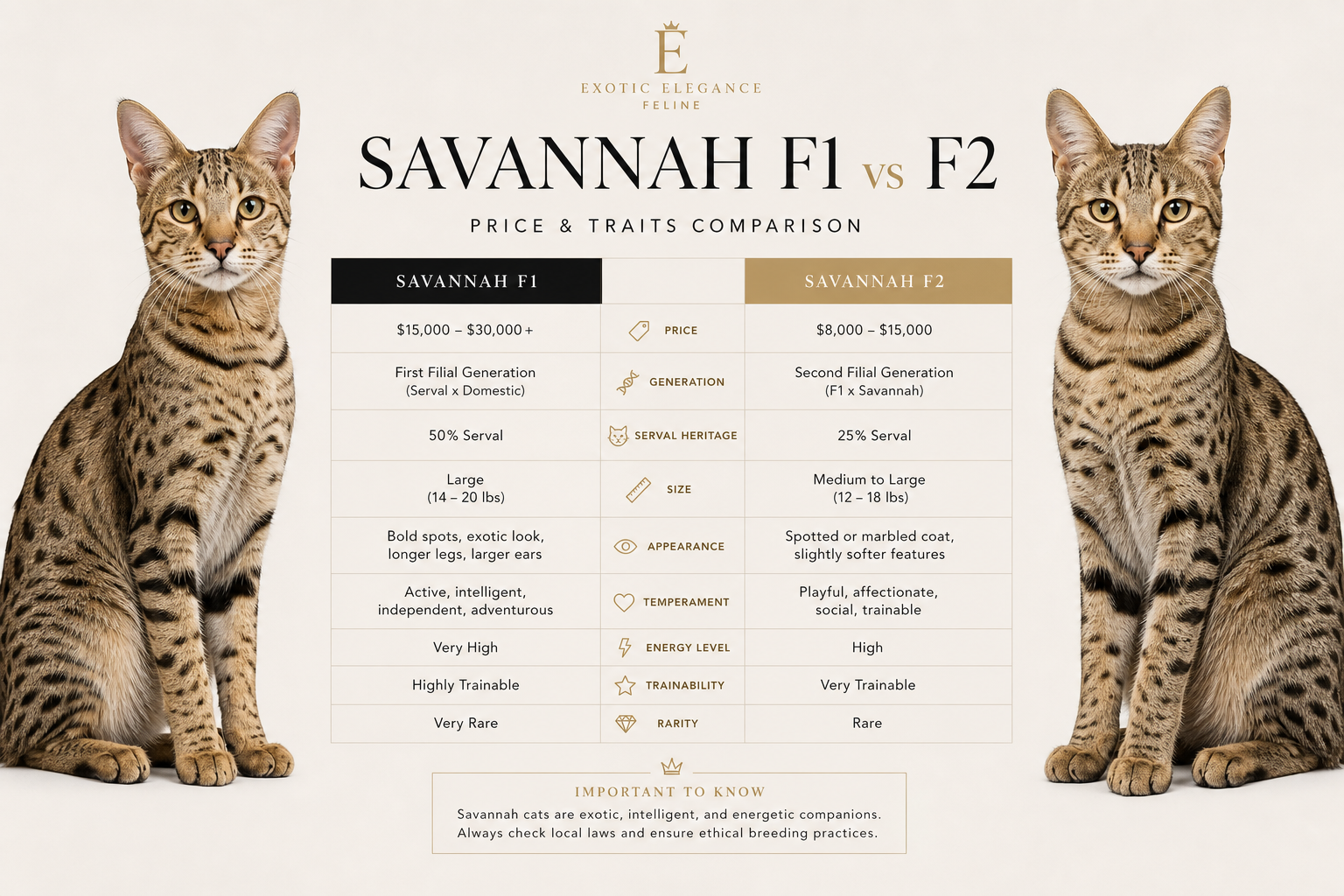
If you are comparing savannah f1 price against savannah f2 price, the gap is not arbitrary. In 2026, an F1 typically commands $15,000–$25,000, while an F2 usually sits in the $7,500–$15,000 range because the F1 is closer to the serval, harder to produce, rarer to source, and more coveted by buyers seeking the most exotic look possible.
For premium buyers in the USA, Dubai, and international markets, the real question is not just which costs more - it is which generation best matches your lifestyle, legal environment, long-term ownership goals, and desired level of wild expression. At Elite Hybrid Cats, a TICA-registered cattery (#115454), that distinction matters because the right choice is as much about fit as it is about price.
Quick answer: What should I pay for an F1 Savannah kitten?
F1 vs F2 in 30 seconds
F1 Savannah price: typically $15,000–$25,000 at Elite Hybrid Cats; HP F1 Savannahs range from $20,000–$50,000
F2 Savannah price: typically $7,500–$15,000
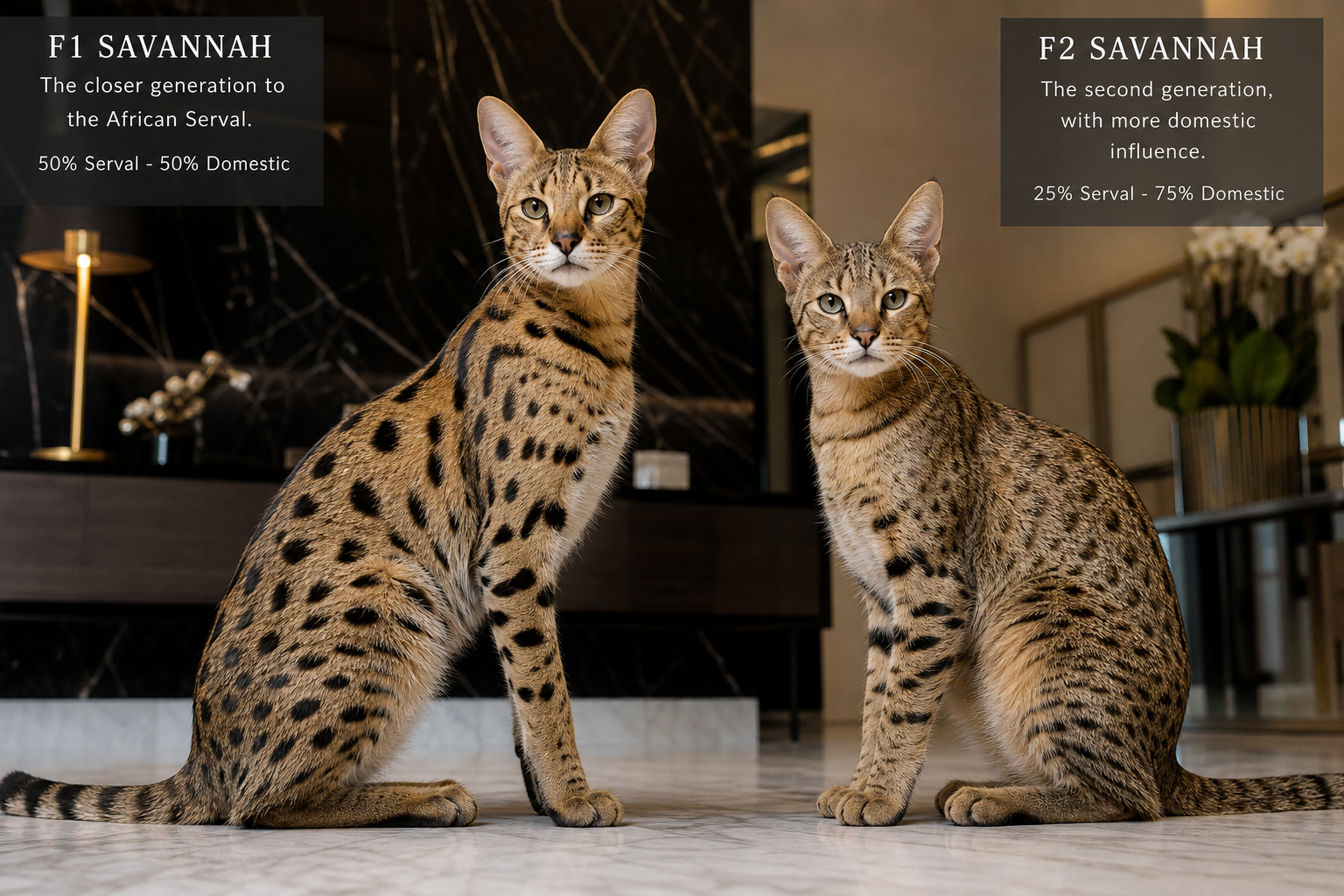
Serval percentage: F1 is about 50% serval, while F2 is usually about 25–30% serval
Size and look: F1s are generally taller, more dramatic, and more visibly exotic; F2s still look striking but often adapt more easily to domestic routines
Temperament: F1s usually require a more experienced owner; F2s are often the more practical luxury choice for households wanting a premium hybrid with a slightly easier socialization curve
Legality and logistics: F2s may be easier than F1s in some jurisdictions, insurance situations, and housing arrangements
Side-by-side price comparison: F1 vs F2 Savannah
Attribute | F1 Savannah | F2 Savannah |
|---|---|---|
Typical 2026 price | $15,000–$25,000 | $7,500–$15,000 |
High-percentage option | HP F1: $20,000–$50,000 | Not applicable |
Serval blood | ~50% | ~25–30% |
Adult weight | ~15–25 lbs | ~12–20 lbs |
Height at shoulder | Typically taller, longer-legged | Tall, but usually less extreme |
Visual phenotype | Most exotic expression, stronger serval influence | Exotic but more blended domestic-hybrid look |
Temperament curve | More intense, highly interactive, owner-dependent | Usually easier for more homes |
Male fertility | F1 males sterile | F2 males often sterile; fertility improves in later generations |
Female fertility | Fertile | Fertile |
Demand | Extremely high | High |
Waitlist length | Usually longer | Often shorter than F1 |
Legal considerations | More restricted in some places | Sometimes easier than F1, but must verify locally |
Vet / transport planning | More specialized | Still specialized, usually simpler |
Ideal buyer | Collector-grade exotic cat owner | Premium buyer wanting balance of beauty and manageability |
Why F1 Savannahs cost significantly more than F2 Savannahs
Competitor articles correctly mention generation, rarity, and breeder quality. What they often under-explain is how each cost layer compounds. The F1 premium exists because several expensive realities stack together at once.
1. Breeding difficulty is much higher with F1s
Producing an F1 Savannah means crossing a serval sire with a domestic queen. This is the most difficult and expensive stage in Savannah breeding.
Why that drives price upward:
Serval access is limited and costly
Breeding compatibility is more complex
Pregnancy outcomes are less predictable
Litter sizes are often smaller
More time, expertise, and failed attempts are built into each successful litter
By contrast, an F2 results from an F1 female bred onward, which is still specialized, but generally less difficult than producing a first-generation hybrid.
"In Savannah cats, the 'F' designation indicates the number of generations removed from their African Serval ancestor. An F1 Savannah has a Serval parent... An F2 Savannah is the second generation, with a Serval grandparent." - Savannah Breed Section
2. F1s deliver the most dramatic serval phenotype
Affluent buyers are not only paying for a cat; they are paying for a specific visual result.
In general, F1 Savannahs are more likely to show:
taller leg length
larger, higher-set ears
longer neck and body
stronger contrast in coat pattern
a more pronounced wild silhouette
An exceptional F2 can still be breathtaking, but the F1 sits closer to the original serval template. That drives market demand, especially for buyers seeking collector-grade companions or a more elite statement pet.
3. High-percentage bloodlines command a premium
Within the F1 category, not all kittens are equal. HP F1 Savannahs at Elite Hybrid Cats represent the highest end of the offering, priced at $20,000–$50,000.
That premium reflects:
stronger serval influence
greater scarcity
more exclusive pairing programs
increased demand from buyers specifically seeking maximum wild appearance
a narrower supply of truly premium bloodlines
For this reason, an HP F1 is not simply “another F1.” It is a more exclusive tier aimed at buyers who want the closest lawful ownership experience to a serval-inspired companion while remaining within the Savannah category.
Elite Hybrid Cats 2026 pricing snapshot
Product line | Price range | Best for |
|---|---|---|
$20,000–$50,000 | Buyers seeking maximum serval blood influence and top-tier exclusivity | |
$15,000–$25,000 | Buyers wanting premier first-generation Savannah ownership | |
$7,500–$15,000 | Buyers wanting luxury hybrid ownership with more day-to-day flexibility |
4. Demand is strongest at the very top of the market
Competitors mention demand, but the true commercial reality is this: buyers shopping F1s are usually not cross-shopping with ordinary domestic breeds. They are comparing:
standard F1 vs HP F1
standard spotted vs rarer finishes such as silver F1 Savannah
U.S. breeder vs international export options
immediate placement vs waitlist access
That pushes F1 values upward because the buyer pool is smaller, wealthier, and more focused on rarity than bargain pricing.
5. The breeder’s overhead is materially different
A reputable cattery’s pricing reflects real costs, not just demand. At the premium end, a serious breeder invests in:
TICA registration
health-tested parents
neonatal and kitten veterinary care
vaccinations
microchipping
specialized nutrition
socialization from birth
contracts and health guarantees
compliance for domestic and international transport
At Elite Hybrid Cats, this premium standard is part of the value proposition - not an optional add-on.
Price is not everything: ownership fit matters more
A mistake many buyers make is assuming the more expensive generation is always the “better” one. That is not how experienced breeders think.
When F2 is the smarter buy
An F2 is often the more intelligent purchase if you want:
a more manageable transition into hybrid ownership
a spectacular exotic appearance without the highest F1 premium
somewhat simpler adaptation to family routines
a lower initial outlay while still owning a rare premium cat
more flexibility in some legal or housing situations
For many luxury households, the F2 is the sweet spot: striking, prestigious, and more practical.
When only F1 will do
An F1 is the right choice if you specifically want:
the closest standard Savannah experience to a serval
maximum visual distinction
a rarer acquisition
stronger collector appeal
a more exclusive bloodline position
a cat that sits at the top end of the premium hybrid market
If your goal is the most dramatic legal hybrid companion available through a TICA-registered cattery, F1 is where that conversation starts.
Genetics, phenotype, and why two cats of the same generation can price differently
Competitor pages often give generation-wide ranges but gloss over intra-generation pricing. In reality, two F1s may be priced differently because one more closely matches the elite buyer’s wish list.
Traits that can raise value inside the same generation
stronger ear set and ear size
taller frame and longer leg length
cleaner facial markings
better contrast and spotting
more refined body proportions
rarer color demand, such as silver, golden, or melanistic black
especially premium serval influence in HP F1 programs
This is why “F1” alone is not enough to predict price. Premium buyers are often evaluating the quality of expression within the generation.
Health screening and early care also affect cost
A low price can be a warning sign.
Responsible breeders absorb the cost of:
parent health testing
kitten wellness exams
vaccinations
parasite screening and prevention
microchipping
high-quality nutrition
safe weaning and developmental support
These standards protect the buyer and the kitten. They also explain why suspiciously cheap F1s or F2s deserve scrutiny.
Import, transport, and international delivery costs
For buyers in the USA and Dubai, transport planning can add meaningful cost and complexity. This matters more with premium kittens because buyers expect compliant, low-stress delivery.
"When transporting cats domestically or internationally, the USDA's Animal and Plant Health Inspection Service advises contacting a USDA-accredited veterinarian as soon as travel is planned." - USDA APHIS
For a premium cattery, that means planning around:
destination-specific health certificate rules
carrier requirements
crate standards
import/export timing
veterinary endorsements
coordination for U.S. nationwide delivery and overseas shipment
This is especially relevant for international clients in Dubai/UAE, where elite buyers often want a clear, concierge-style shipping process rather than a patchwork arrangement.
For more details on overall pricing, see Savannah cat pricing and the breed guide.
5-year total cost of ownership: F1 vs F2
Purchase price is only the beginning. Serious buyers should compare total ownership, not just acquisition.
Estimated 5-year ownership overview
Cost category | F1 Savannah | F2 Savannah |
|---|---|---|
Initial purchase | $15,000–$25,000 | $7,500–$15,000 |
Premium setup | Higher | Moderate to high |
Diet | Higher on average | Moderate to high |
Routine vet care | Higher potential due to specialist preference | Moderate to high |
Insurance / specialty care | More variable, often higher | Usually somewhat easier |
Travel / relocation logistics | More complex | Usually somewhat simpler |
5-year budget profile | Highest overall investment | More balanced luxury ownership |
Setup costs both buyers should expect
Regardless of generation, a premium Savannah owner should plan for:
large cat trees and vertical enrichment
secure carrier and travel crate
high-quality litter setup
premium food
interactive toys and environmental enrichment
annual veterinary care
emergency reserve fund
possible behavior or acclimation support
An F1 owner should generally budget more aggressively because the cat’s energy, stature, and environmental needs may be more demanding.
Legal and practical considerations: USA, EU, UAE
Legality is one of the most overlooked parts of the F1 vs F2 decision.
United States
Rules vary by state, county, and city. Some areas restrict early generations more than later ones. Before placing a deposit, confirm:
state legality
county or municipal hybrid restrictions
landlord or HOA rules
insurance carrier rules
exotic animal permit requirements, if any
Dubai / UAE and international buyers
Import approval, veterinary documentation, airline routing, and receiving-country requirements can all affect which generation is more practical. Premium international buyers should always confirm current rules before reserving a kitten.
A good breeder should help you understand the process. That is part of the value of working with an experienced export-capable cattery rather than an unverified seller.
F1 vs F2: honest decision framework
Choose an F1 if you want:
the highest prestige tier short of HP F1
the strongest serval look
maximum rarity
the most exclusive ownership experience
a premium acquisition where aesthetics and bloodline matter most
Choose an F2 if you want:
a lower entry point into premium Savannah ownership
strong visual exotic appeal
a more adaptable day-to-day companion
better balance between luxury and practicality
a cat that still feels elite without stretching into F1 pricing
Can an F2 look almost like an F1?
Sometimes, yes - but not consistently enough to erase the price difference.
A very good F2 can be stunning and may satisfy buyers who primarily want the Savannah silhouette, spots, and elevated look. But buyers who are laser-focused on maximum serval resemblance, blood percentage, exclusivity, and market scarcity usually continue to prefer the F1.
That is the crux of the price gap.
Why elite buyers still pay more for F1 Savannahs
The competitors generally explain cost from the breeder’s side. The missing piece is the buyer psychology at the top end of the market.
Buyers choose F1s because they value:
rarity over affordability
bloodline prestige over convenience
statement ownership over compromise
top-tier phenotype over “close enough”
That does not make the F2 lesser. It simply serves a different buyer. In many households, the F2 is actually the superior decision because it delivers the hybrid experience with fewer compromises in daily life.
Why Elite Hybrid Cats is a credible place to compare F1 and F2 options
At Elite Hybrid Cats, the conversation is not generic. The cattery focuses on premium hybrid ownership with an emphasis on:
TICA registration - TICA cattery #115454
specialized focus on premium Savannahs and exotic hybrids
access to high-end bloodlines including HP F1, F1, and F2
rare, high-demand color directions including silver, golden, and melanistic black
health-tested parents, vaccinations, microchipping, and structured placement
U.S. delivery, Dubai shipping, and worldwide export coordination
educational resources for first-time and experienced hybrid buyers alike
If you are actively comparing generations, start with the product pages for HP F1 Savannahs, F1 Savannahs, and F2 Savannahs, or browse available kittens.
Final verdict
The difference between savannah f1 price and savannah f2 price comes down to one thing: proximity to the serval drives rarity, complexity, and demand.
Choose F1 if you want the more exclusive, higher-percentage, visually extreme luxury hybrid and are prepared for the higher investment.
Choose F2 if you want an exceptional exotic cat with stronger practicality and a lower acquisition cost.
For buyers who want transparent pricing, elite bloodlines, and a breeder that understands both U.S. and international placement, Elite Hybrid Cats offers a more informed path than simply shopping for the cheapest kitten online. If you are ready to compare the right generation for your home, start with F1 Savannahs, F2 Savannahs, or contact the cattery for guidance.
FAQ
How much does a F2 Savannah cat cost?
A F2 Savannah cat typically costs $7,500–$15,000 in 2026 when purchased from a reputable premium breeder. Price varies based on phenotype, bloodline quality, breeder standards, and whether the kitten strongly expresses the exotic Savannah look.
How expensive is an F1 Savannah cat?
A standard F1 Savannah typically costs $15,000–$25,000, while a high-percentage HP F1 can range from $20,000–$50,000. The premium reflects rarity, more difficult breeding, stronger serval influence, and higher market demand.
What is the difference between F1 and F2 Savannah cats?
An F1 Savannah has a serval parent and is about 50% serval, while an F2 Savannah has a serval grandparent and is usually about 25–30% serval. F1s are generally more expensive, rarer, taller, and more visually exotic, while F2s often offer a better balance of appearance and manageability.
What's the difference between F1, F2, F3, F4, and F5 Savannah cats?
The F-number shows how many generations a Savannah is removed from the African serval. Lower numbers such as F1 and F2 are closer to the serval and usually cost more, while later generations like F3–F5 are generally more domesticated in behavior, easier to place, and often lower in price.
How expensive is an F1 Savannah cat?
In practical market terms, an F1 Savannah is one of the most expensive Savannah generations, commonly priced from $15,000 to $25,000 and higher for elite bloodlines. Buyers are paying for rarity, phenotype, breeder expertise, and proximity to the serval ancestor.
What's the difference between F1, F2, F3, F4, and F5 Savannah cats?
The main differences are serval percentage, appearance, fertility, legality, and price. F1 and F2 are the premium early generations, while later generations progressively move farther from the serval and often become more accessible for typical households.
Looking for a TICA-registered Savannah, Serval or Caracal?
Elite Hybrid Cats — TICA #115454 · Serving USA, Dubai & worldwide · 12+ years experience.
See available kittens →